By 2026, Fortnite has evolved into a sprawling platform, but the Impostors mode remains one of the clearest examples of Epic Games' willingness to chase a cultural moment. I remember logging in after the trailer dropped and feeling an odd mix of curiosity and déjà vu. The pitch was simple: two Impostors infiltrate a facility, eight Agents try to complete tasks and vote them out. It was Fortnite's take on hidden-role social deduction.
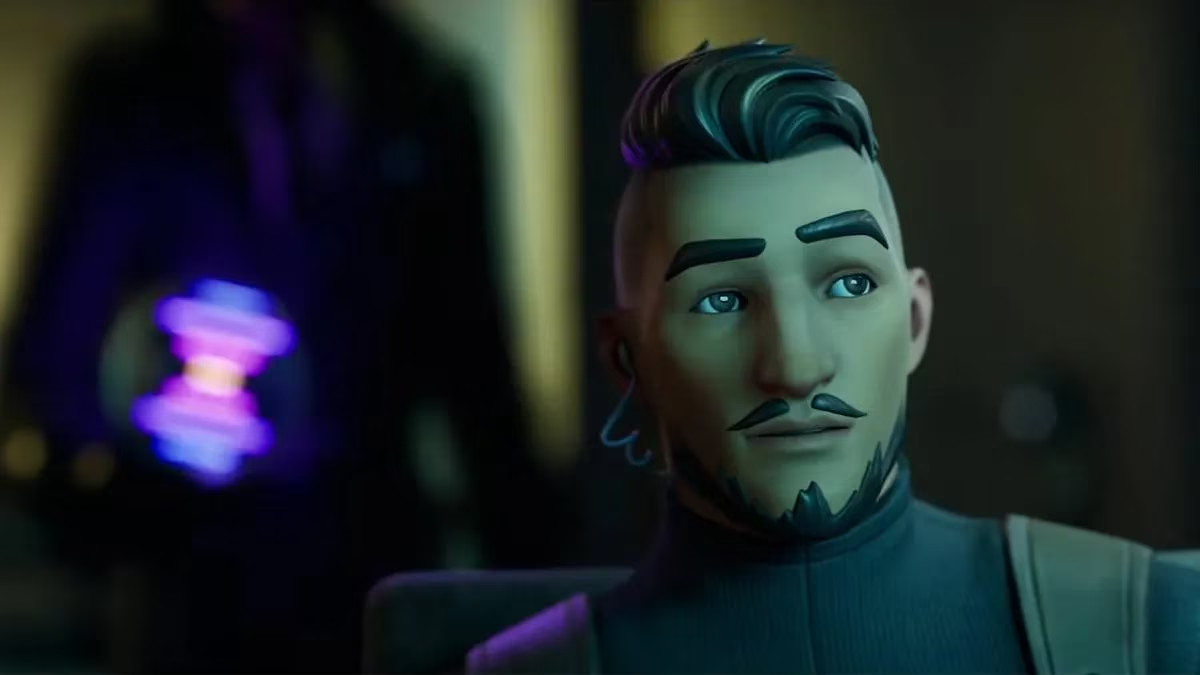
The setting was The Bridge, a secret base run by the Imagined Order. From the first match, I understood the loop. As an Agent, I had to repair the Battle Bus, calibrate drops, and monitor the Storm. As an Impostor, I had to blend in, sabotage, and eliminate without being caught.
How the mode works
Agents win by completing assignments or expelling every Impostor. Impostors win by reducing the Agent team to equal or lower numbers before discovery. The critical social mechanic is Forcing a Discussion. When a body is found or suspicion builds, players can call a meeting and vote. I have seen innocent Peely skins get ejected purely because the lobby decided they looked suspicious.
Here is a quick breakdown:
| Role | Goal | Key actions |
|---|---|---|
| Agent | Complete tasks and identify Impostors | Repair Battle Bus, calibrate drops, monitor Storm, call discussions, vote |
| Impostor | Eliminate Agents and avoid detection | Sabotage, teleport players, disguise as Peely, pause assignments |
Impostor toolkit
Impostors are not defenseless. They can teleport players across the map to create chaos. They can temporarily turn every character into Peely the Banana, making identity hard to track. They can pause active assignments to stall Agent progress. But the strongest weapon is social manipulation. I have watched Impostors calmly steer votes toward an innocent Agent and escape with a perfect victory.
The Among Us debate
The similarities to Among Us were obvious. Fans noticed immediately. InnerSloth later told IGN that it did not collaborate with Epic Games on Impostors. Did Epic copy? In fairness, hidden-role games existed long before Among Us. The format traces back to party games like Mafia, created in 1986. Among Us did not invent social deduction, but it turned the formula into an online phenomenon. Epic's Impostors mode arrived at the peak of that wave. To me, it felt less like an homage and more like a calculated business move.
A pattern of trend chasing
This is not new behavior for Epic Games. Fortnite began as a cooperative zombie shooter before pivoting to battle royale after PlayerUnknown's Battlegrounds exploded. Epic even fought a lawsuit from PUBG's developers. When a genre becomes popular, Epic tends to build a Fortnite version. Impostors fits that pattern. I do not think that is necessarily bad. Players get a polished, free mode inside a game they already play. But the inspiration was hard to ignore.
Legacy in 2026
By 2026, social deduction remains a staple in Fortnite's creative ecosystem. The Impostors mode may not dominate headlines the way it did in 2021, but its influence is visible in user-made maps and official limited-time events. The mode showed that Fortnite could host slower, talk-heavy experiences alongside its high-speed battle royale. It also proved that Epic can react quickly to a trend and package it for a massive audience.
I still return to The Bridge occasionally. The tasks feel simple, the voting chaotic, and the betrayals personal. In a game often defined by building and shooting, Impostors gave me a different kind of tension: the quiet panic of being watched while faking a calibration. Whether or not it was original, it worked.
At launch, Fortnite was available on PC, PlayStation 4, PlayStation 5, Switch, Xbox One, and Xbox Series X/S. As of 2026, the game continues to receive updates, and the Impostors experiment remains a memorable chapter in its history.