There’s a specific kind of disorientation that washes over you when you step into an IKEA showroom in 2026. It’s not just the labyrinthine layout—which still feels like a kindly designed minotaur’s living room—but the way every corner is dressed like a frozen moment of domestic life. Books lie open on coffee tables that have never known a coffee ring. Frames hold photos of families you’ll never meet. And yesterday, wedged between a reasonably priced media cabinet and a sofa with an unpronounceable name, I found the most brilliantly unhinged tribute to gaming culture I’ve ever seen: a row of fake video game cases, each one a cheap, copyright-dodging masterpiece.
I had wandered into the living room section hunting for a new desk, but as any IKEA pilgrim knows, the arrows on the floor are more suggestion than commandment. I was knee-deep in a room setup clearly designed for a sleek, modern entertainment center when my eyes tripped over something wrong. On a low shelf, next to a faux succulent and a remote control that probably controlled nothing, stood a lineup of game cases I almost didn’t register. Then I read the titles and let out a laugh so sudden a couple across the pathway glanced up from their argument about shelf brackets.
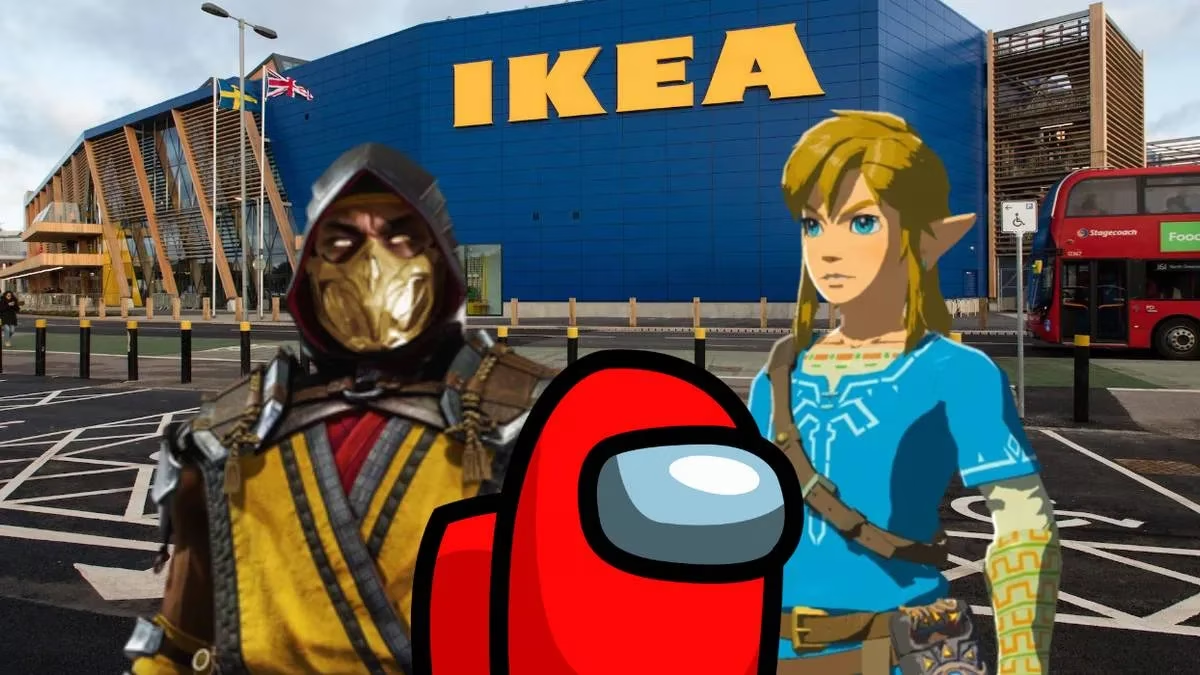
The games were like linguistic jigsaw puzzles—each one a scrambled portrait of a blockbuster franchise, begging your brain to solve the anagram before the joke landed. “Kombat Mortal” was the easiest, a brash transposition that instantly summoned images of Scorpion’s spear and Sub-Zero’s spine-ripping. Next to it, “Among Gus” made me bite my lip; the title is a perfect distillation of every meme that ever asked whether Red was sus, packaging the entire social deduction phenomenon into a single, absurd name that would only make sense if you’ve spent too many hours in a spaceship kitchen pretending to swipe a card. “Breath of the Wind” was an almost poetic reinvention of a Zelda classic, transforming Hyrule’s existential gasp into something meteorological and faintly perfume-like. “The Last of Him” sounded less like a post-apocalyptic epic and more like a breakup told through fungal zombies, which, honestly, isn’t far off. “Fighter Street” turned Capcom’s globe-trotting brawlers into a sensible suburban road. And “Unsalved”—shorn of its “Uncharted” origins—became a word that means the opposite of soothed, as if the game would leave you more chafed than when you started.
I crouched down, pretending to examine the stitching on a throw pillow, and took mental photographs. This wasn’t just a lazy attempt to fill shelf space. IKEA has long used dummy props—books with titles like “Ett,” mock laptops, and even famously large cardboard PlayStation 5s back in 2021 when real consoles were as elusive as a polite parking lot—to help customers visualize scale. Back then, the company playfully called the PS5 “meme-ishly oversized,” a wink that told me someone inside the blue-and-yellow giant actually enjoyed video games. These game cases felt like a direct descendant of that humor, a knowing treasure hunt for anyone who’s ever sprinted across an IKEA warehouse with a flat-packed Malm in their cart and a dream in their heart.
The entire setup reminded me of the way our brains learn language as children, picking up fragments and reassembling them into meaning. The fake titles are misaligned doppelgängers of the real things, like seeing your own reflection in a spoon—recognizable but hilariously distorted. I thought of the legendary IKEA catalog that appeared inside Animal Crossing: New Horizons in 2021, complete with tiny pixelated Ektorp sofas. This was the reverse: gaming bleeding into the showroom floor, not as an advertisement but as a shared joke between the store and anyone nerdy enough to notice.
I lingered by that shelf for an embarrassingly long time, cataloging each case as if I’d discovered a rare beetle. A child wandered by, pointed at “Among Gus,” and asked her dad if Gus was a crewmate. The man shrugged, clearly not in on the joke, and I stood there feeling part of a secret society. That’s the magic of these little anachronisms—they turn the impersonal, slightly sterile experience of browsing furniture into something conspiratorial. IKEA’s showrooms are stages, and these game cases are deliberately misplaced props, ready to be discovered by the audience members who aren’t just looking for a new kitchen island.
My own relationship with IKEA has always oscillated between awe and exhaustion. The stores are physical manifestations of hope, every room a promise that your life could be that ordered, that calm, that Swedish. But they’re also overwhelming, a maze that siphons your energy and replaces it with a craving for meatballs. Finding these parodies was like stumbling upon a developer’s Easter egg in a open-world map—a small, human glitch in a system designed to be meticulously seamless. It made me wonder how many thousands of visitors had walked past the same shelf without blinking, and how many, like me, had doubled over with a grin usually reserved for rare console leaks or Steam sale victories.
When I finally left, clutching a bag of frozen meatballs and a receipt for a desk I no longer remembered choosing, the game cases stayed with me more than any purchase could. They are a gamer’s inside joke, printed in a muted sans-serif font on cardboard, tucked into a Swedish furniture labyrinth. In a world where intellectual property is guarded by battalions of lawyers, these little distorted titles are a quiet, ridiculous act of rebellion—a gentle reminder that even a global retail giant can’t resist playing a little game of word scramble. And as I drove home, I couldn’t stop thinking: if I ever find “Craft Mine” or “Turrets Defense” on a future visit, I’ll know the prank is alive and well, still crouched in the showrooms, waiting for someone who looks at a couch and sees a checkpoint.