Hey everyone! It's your favorite tech/gaming enthusiast back at it again. Today, I want to take you on a wild ride down memory lane, but not the usual kind. We're talking about the ultimate form of nostalgia and tech ingenuity: playing full-blown, iconic video games on a TI graphing calculator. Yeah, you heard that right. While these devices were our trusty (and expensive) sidekicks through high school and college math classes, a small but fiercely dedicated community of programmers has been turning them into secret gaming powerhouses for years. Even in 2026, this scene is alive and kicking, with devs constantly pushing the limits of what these pocket-sized machines can do. Let's dive into some of the most mind-blowing ports that prove creativity knows no hardware bounds.
The Classics Never Die: Arcade Legends Reborn
First up, let's talk about the games that defined generations. It's no surprise that timeless arcade hits have found a second home on calculator screens.
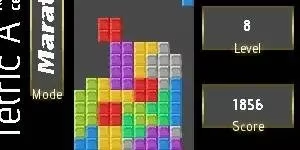
Tetris on a calculator feels almost... poetic, right? It's the perfect blend of math and fun. The version for the TI-84 Plus CE, crafted by KermMartian, is legendary in the community. It's not just a simple port; it boasts five unique gameplay modes! From a marathon mode to a brutal sprint, it turns your study session into a block-stacking championship. The spatial reasoning required feels oddly appropriate for a device meant for graphing functions.
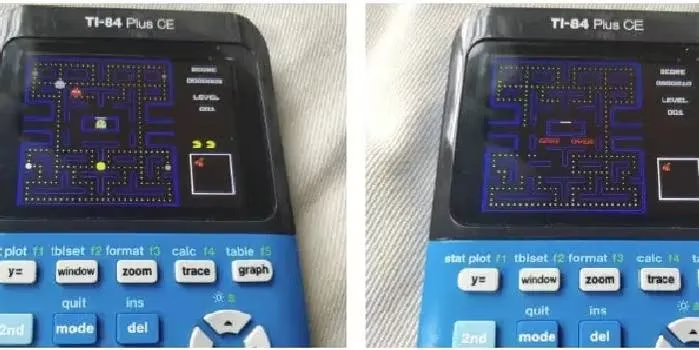
Then there's Pac-Man. The yellow dot that ate the world! Thanks to the wizardry of MateoConLechuga, this arcade titan runs flawlessly on the TI-84 Plus CE. The bright, chunky sprites translate shockingly well to the calculator's limited display. Sure, you don't get the iconic waka-waka sound effects (RIP), but the core gameplay—dashing through mazes, munching dots, and fleeing from Blinky, Pinky, Inky, and Clyde—is all there. It's a testament to brilliant pixel art and efficient coding.
Modern Giants, Miniaturized
Now, this is where things get absolutely insane. Programmers haven't stopped at 80s classics; they've brought some of the biggest games of the 21st century to this humble platform.
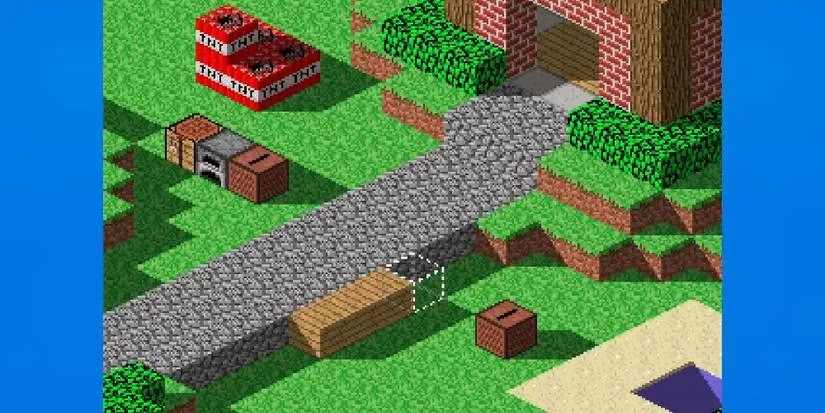
Minecraft. On a calculator. Let that sink in. The game that took over every console, PC, and phone has been condensed into an isometric creative mode experience. YouTuber The Science Elf pulled off this programming miracle, allowing you to build simple structures with a variety of blocks across multiple worlds. The clever rendering tricks used to make those blocky landscapes appear on such limited hardware are nothing short of genius. It's the ultimate sandbox, now fitting in your pencil case.
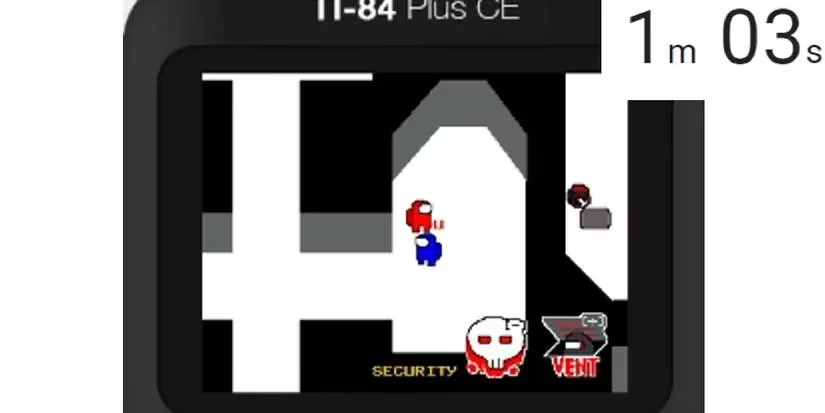
The social deduction phenomenon Among Us, which basically kept us all sane during lockdowns, also got the port treatment. The channel Everyday Code created a version for the TI-84 Plus CE. Now, it's a single-player experience where you play as the Impostor (which, let's be honest, is the fun part for many of us). The artwork is instantly recognizable—those little crewmate silhouettes are unmistakable even in calculator form. It's a quirky, fun way to relive the paranoia between calculus problems.
Nintendo's Finest, Against All Odds
If bringing Minecraft to a calculator is crazy, then porting Nintendo's most beloved franchises is pure, unadulterated madness. And yet, here we are.
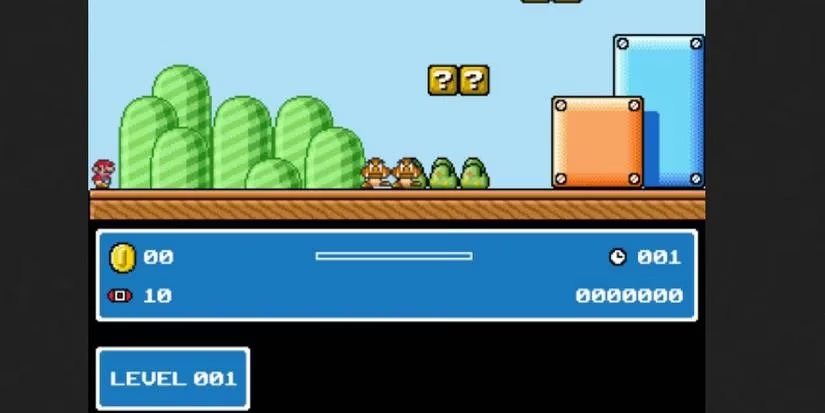
Behold, Oiram (that's 'Mario' backwards, get it?). Created by MateoConLechuga, this is a love letter to Super Mario Bros. 3. The visuals do an incredible job of capturing the feel of the NES classic on the calculator's screen. But it doesn't stop there—it even includes a level editor, turning your TI device into a pocket-sized Mario Maker! Creating your own platforming challenges during a boring lecture? That's the dream.
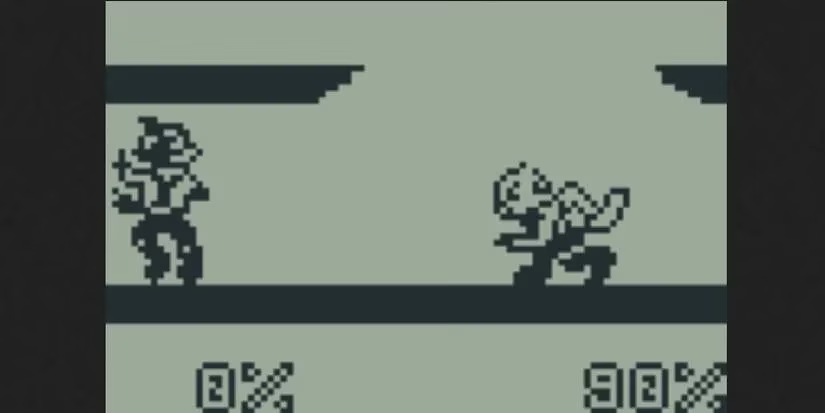
Perhaps the most technically impressive feat is a port of Super Smash Bros. for the older, monochrome TI-83 Plus and TI-84 Plus. Programmer Hayleia worked what can only be described as magic. The fighters are well-animated, the camera zooms dynamically, and the best part? It has multiplayer! You can battle a friend on a single calculator or link two devices together. It's a chaotic, wonderful proof-of-concept that shows the sheer dedication of this community.
The Apex of Ambition: First-Person Adventures
Some ports are about capturing the spirit of a game. Others are about attempting the impossible. These next two fall firmly into the latter category.
We have to talk about Doom. The game that runs on everything. Toasters, printers, pregnancy tests—you name it. So of course, it runs on a calculator. A project by Alexis Guinamard, Guillaume Hoffmann, and Raphaël Siryani resulted in zDoom. It's a rudimentary, flat-plane version that chugs when enemies appear, but by the gods, it's Doom! You can run around and shoot demons on a device meant for plotting parabolas. That's a win in my book.
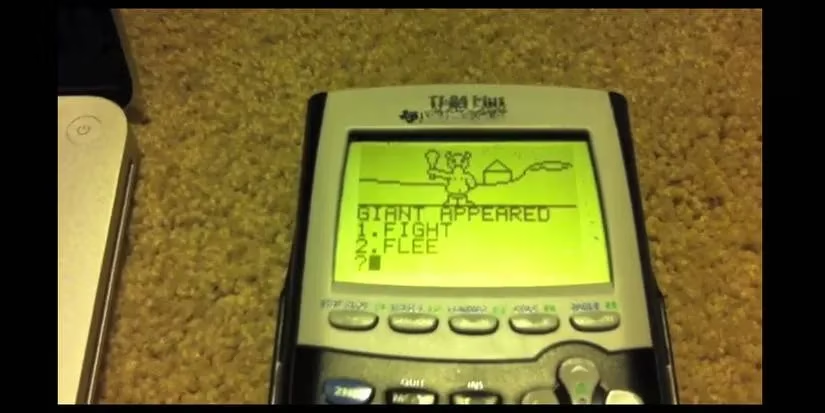
And then, there's the granddaddy of open-world RPGs: The Elder Scrolls V: Skyrim. YouTuber Evan Heaton somehow condensed the land of the Nords into a text-based adventure for the TI-84. You can explore regions, collect dragon souls, and battle creatures through a clever menu-driven interface. It has a simple overworld map and illustrations of foes. It captures the essence of adventure in Skyrim, just in a wildly different format. From the peaks of the Throat of the World to the depths of a calculator's RAM, the Dragonborn's journey continues.
Why This Still Matters in 2026
So, why am I, in the year 2026, still fascinated by games on hardware that's decades old? It's simple:
-
🔥 The Spirit of Hacking: It represents the pure, unadulterated joy of making something run on hardware it was never designed for. It's the digital equivalent of fitting a V8 engine in a golf cart.
-
💾 Preservation & Creativity: These ports are acts of preservation and creative expression. They keep classic game mechanics alive in new, constrained environments, forcing developers to be incredibly innovative.
-
📟 A Living Community: The TI calculator gaming scene isn't a relic. New ports and homebrew games are still being made. It's a niche, but a passionately active one.
In an era of 8K graphics and cloud gaming, there's something beautifully rebellious and nostalgic about booting up Skyrim or Smash Bros. on the same device you used to cheat on your algebra test. It's a reminder that fun and ingenuity aren't defined by processing power, but by the creativity of the community. So next time you see a TI calculator, remember—it's not just for math. It's a tiny, beige arcade cabinet waiting to be unlocked. What's your favorite calculator game port? Let me know in the comments! 👇
This overview is based on perspectives surfaced in Reddit - r/gaming, where players regularly trade tips and war stories about running unexpected classics on unconventional hardware—exactly the kind of tinkering ethos behind TI-calculator ports like Doom, Minecraft-inspired builds, and arcade staples that still feel magical on a tiny screen.